Solar Storms
Our world is surrounded by a magnetic wall that varies in strength stronger and weaker as the sun moves. That quiet setting doesn’t stand out frequently. It changes more dramatically some days.
The study that this piece was based on asked a simple question: Is there a direct link between the number of heart attacks people have on Earth and the state of the Earth’s magnetic field, which is affected by solar storms? Over several years, doctors in Brazil looked at how many people went to the hospital with a myocardial infarction (heart attack).
Age, sex, and whether or not a patient lived to be discharged were all kept track of. Then, they compared those numbers with daily magnetic activity scores to see if the trends matched.
The team didn’t see a clear pattern to talk about until they matched health information with data on space weather.
Luiz Felipe Campos de Rezende, who works at Brazil’s National Institute for Space Research (INPE), later talked about what they saw and how they checked it.
This encompassed comparisons among age cohorts and a subsequent computer-based investigation to validate the signal.
Solar storms and myocardial infarctions
The inquiry was precise: do admissions for heart attacks and in-hospital fatalities associated with these incidents exhibit varying timing on days when the magnetic field is significantly disturbed?
The team sought to ascertain whether women and men had identical responses.
They did not attempt to establish causality. They sought a correlation in the timing of results during tranquil, moderate, and tumultuous days. The framework ensured that the analysis remained anchored in the evidence provided by the records.
The researchers employed the Planetary Index (Kp-Index), a standardized global metric that categorizes daily magnetic activity from extremely tranquil to highly disturbed. The index provided them with a straightforward daily metric for comparison.
with the hospital totals.
They categorized the calendar into tranquil, moderate, and tumultuous days, subsequently tallying admissions and in-hospital fatalities within each category. They categorized the numbers by sex and age group to identify notable disparities.
The data revealed
Women experienced an increased incidence of heart attack admissions during periods of heightened solar activity and solar storms that disrupted Earth’s magnetic field, compared to tranquil days. The signal was especially prominent among middle-aged and elderly women.
In identical age cohorts, in-hospital mortality increased on tumultuous days vs. tranquil ones.
Men did not exhibit the same pronounced increase on disturbed days among those groups, although they represented a higher number of admissions overall in the dataset.
The study focused not on the overall incidence of heart attacks, but rather on whether their timing varied with space weather conditions.
Correlating myocardial infarctions with solar phenomena
The researchers categorized the examined days as tranquil, moderate, or tumultuous. The health data were categorized by sex and age category [up to 30 years; between 31 and 60; over 60 years].
Luiz Felipe Campos de Rezende, a researcher at Brazil’s National Institute for Space Research (INPE) and the article’s corresponding author, informed Agência FAPESP that the incidence of heart attacks in men is nearly double, irrespective of geomagnetic circumstances.
“However, an examination of the relative frequency rate of cases reveals that, for women, it is markedly elevated during disturbed geomagnetic conditions in contrast to calm conditions.”
Enhancing layers of confidence
Statistics can be deceptive if a certain method introduces bias into the results.
To mitigate that risk, the team employed clustering, which organizes analogous cases without prior identification of significant factors. The model was provided with the daily magnetic category and strength (Kp-Index), in addition to sex and age.
A cluster identified disturbed-day cases predominantly involving women in their mid-60s.
This corroborated the simpler counts, enhancing confidence that the observed pattern was not an anomaly of a singular methodology.
Statistically significant correlation between solar storms and heart conditions
This study was observational and utilized historical records from a single city. “Observational” denotes the absence of experimentation and intervention, relying solely on meticulous alignment of timeframes.
The architecture does not allow for the proof that a magnetic disturbance induces a heart attack.
Admissions and in-hospital fatalities among women, particularly in older demographics, were observed to be more prevalent on days when solar storms disrupted Earth’s geomagnetic field compared to tranquil days within the examined context.
The authors explicitly acknowledge this limitation and refrain from making any causal assertions.
What makes this link between solar storms and heart conditions credible?
The heart operates with minute electrical impulses that synchronize each contraction. Nerves depend on electrical impulses, and several bodily rhythms adhere to cycles that can be influenced by external stimuli.
Certain experts propose that external electromagnetic fluctuations may exert a minor influence on systems already experiencing stress.
If an individual possesses compromised arteries or an unstable rhythm, even a minor stimulus may influence the timing of an event.
This is a hypothesis. The study did not examine a mechanism; nonetheless, it highlights a specific question for future research to address.
Extensive datasets and predictive analysis
Extensive datasets sourced from various areas and latitudes could ascertain whether the identical timing pattern persists across diverse magnetic conditions.
Comprehensive patient information—including drugs, preexisting diseases, and daily variables—could elucidate the individuals most susceptible and the reasons for their sensitivity.
Integrating health data with local magnetic measurements and additional environmental variables, such as temperature and air quality, would facilitate the differentiation of overlapping effects.
This strategy transitions the discipline from indicative temporal associations to causal elucidations.
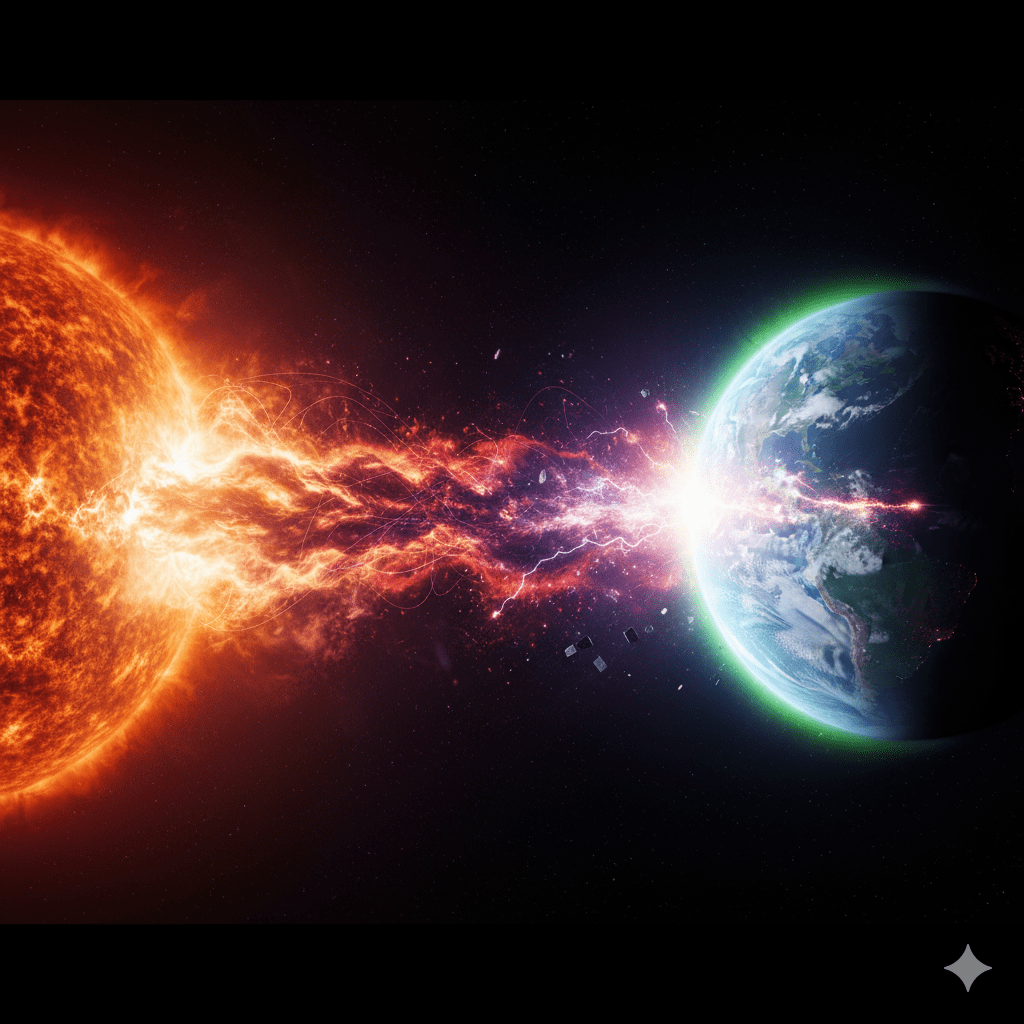
“Scientists globally have been attempting to forecast geomagnetic disturbances, but current accuracy remains inadequate,” states Rezende.
“Once this service is improved—and if we confirm that magnetic disturbances affect heart function—we will be able to look at ways to prevent issues from a public health perspective, especially for people with existing heart problems,” he added.
Solar storms, myocardial infarctions, and subsequent actions
Public health teams currently utilize short-term alerts for heat and pollution.
Should future research establish a conclusively reliable correlation between solar storms and increased heart attack admissions, hospitals may prepare for a little rise in cardiology cases during significant disruptions of Earth’s magnetic field.
Individuals with diagnosed cardiac disease should adhere to standard recommendations provided by healthcare professionals, particularly during solar storm alerts: adhere to prescribed medications, monitor for symptoms, and refrain from excessive physical effort.
These measures conform to established care protocols and warrant no concern.
Numerous other inquiries require resolution; nonetheless, the data provided by this study unequivocally indicates the presence of an element that warrants further examination.
In the interim, monitor the notifications from the Space Weather Prediction Center (SWPC) and respond appropriately. It is preferable to exercise caution rather than regret, particularly when the precautionary measures demand minimal effort.
The comprehensive analysis was published in the journal Nature Communications Medicine.
Homeopathy helps to prevent the negative influence of solar storms on human bodies.
Numerous scientific studies indicate that homeopathy can mitigate the impacts of solar activity on humans. Homeopathy is a scientific discipline predicated on the notion that extensively diluted chemicals can remedy illnesses. Scientific evidence now substantiates the notion of using these dilutions to prevent astronomical phenomena.
When interacting with Earth’s magnetic field, solar activity, including solar flares and coronal mass ejections, can induce geomagnetic storms. Homeopathic remedies can’t prevent humans from reactions to solar storms, but they can alleviate the symptoms and deterioration of humans’ conditions as a result of the storm.
A pleasurable day in the sun may occasionally result in significant consequences for your skin and health. That is the moment to seek cooling shade and utilize your homeopathic summer kit.
Several essential medications should be readily available throughout the summer peak. Natrum muriaticum 30C alleviates sun-induced rashes or sun allergies. * Hypericum perforatum 30C may alleviate sun-induced rashes, particularly when administered prior to exposure. *Urtica urens 6C may alleviate sun allergies characterized by a stinging or prickly sensation and might mitigate itching exacerbated by cold and water. *
For an intense sunburn accompanied by a throbbing sensation in the skin, the sole remedy to employ is Belladonna 6C. It is the primary treatment employed for erythematous, painful, hyperemic, and edematous skin. Cantharis 6C may also be utilized for sunburn or any severe second-degree burn characterized by significant pain and blistering. *
Cuprum metallicum 6C is linked to abrupt muscle cramps that manifest and resolve suddenly. Glonoinum 6C and Belladonna 6C are commonly employed when a person exhibits facial erythema, pulsating cephalalgia, and pyrexia following extended exposure to heat. Administer Belladonna 6C in cases of excessive perspiration and Glonoinum 6C for predominant pulsing headaches. It is crucial to recognize that heat stroke or sunstroke is a medical emergency and necessitates evaluation by a healthcare professional. Ensure that the affected individual remains adequately hydrated, particularly youngsters and the elderly.
If you believe your body is influenced by the solar storms and you frequently feel awkward during intense solar activities, homeopathic medicine, ayurvedic preparations, and acupuncture may help you.
Contact our clinic at (267) 403-3085 for further details.